



July 18, 2026
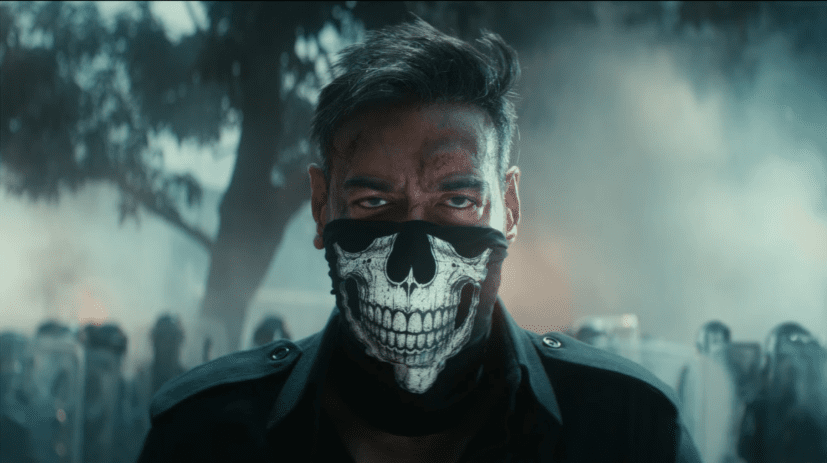
Bollywood actor Ajay Devgn’s upcoming film, Chauhaan, produced by Jio Studios, has come under fire for its latest trailer. In the clip, Ajay Devgn’s character complains that tear gas and pellet guns are not effective against Kashmiris since tear gas masks can be bought online and “Pellet guns… limited damage.”
Devgn’s callous lines make a mockery of Kashmiris, who have been the targets of indian aggression through the use of pellet guns for decades. Kashmir’s case has been labeled as the world’s first mass blinding by several journalists, human rights groups and activitists. According to Al Jazeera, more than 1,000 Kashmiris have lost their vision, partially or completely, since New Delhi introduced pellet guns in 2010 to control “unrest” in the occupied territory.
The scene completely dehumanizes Kashmiris, portraying protesters as rabid unfeeling animals, unperturbed by the fresh pellet wound in their eye. The fictional Kashmir truly does not seem to feel the effects of his wound, allowing the fictional portrayal to completely dismiss the very real pain of real victims. Meanwhile, Ajay Devgn portrays mass blinding as heroic.
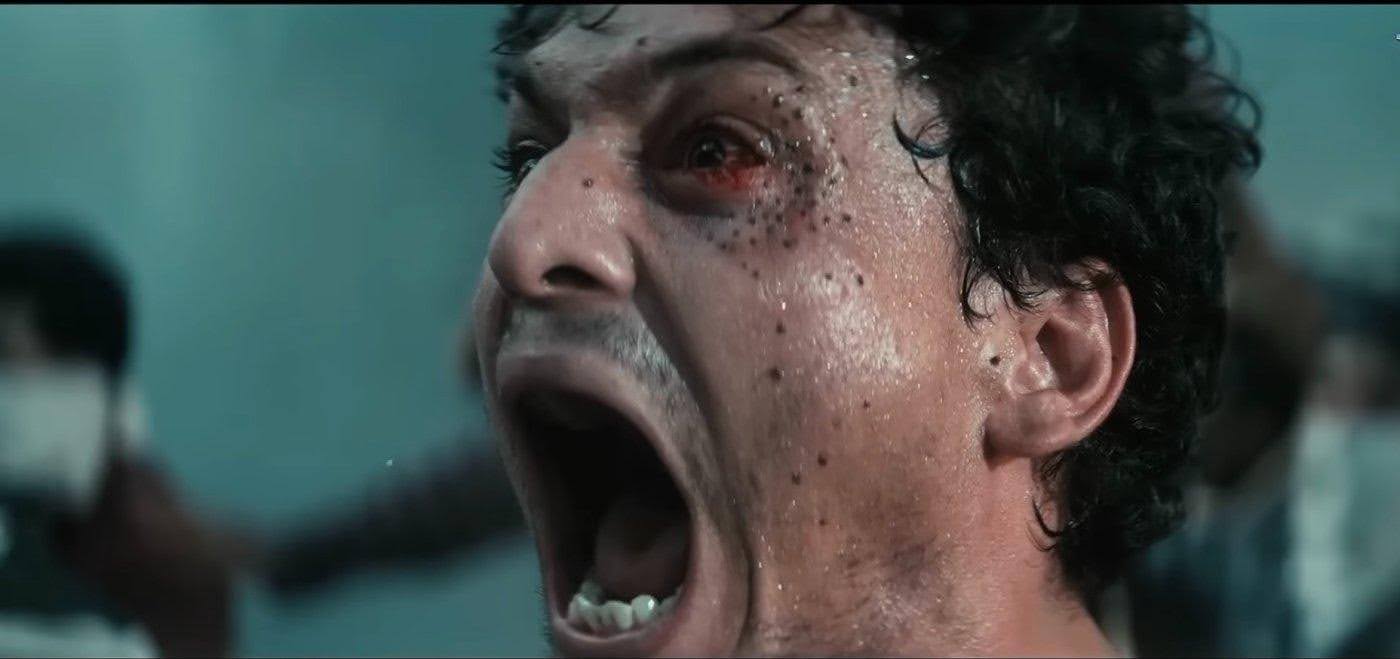
Still from Chauhaan
Amnesty International has challenged the indian government’s repeated claim that pellet guns are a “necessary evil” for non-lethal crowd control. In its investigations into the 2016 Kashmir uprising, Amnesty described 12-gauge pump-action shotguns as inherently inaccurate and dangerously indiscriminate.
Upon being fired, pellet guns release hundreds of tiny iron balls that tear into the flesh and stay buried deep inside the tissues, from where it is nearly impossible to remove them.
This becomes even more horrifying when reports reveal that 14% of pellet gun victims are under the age of 15.
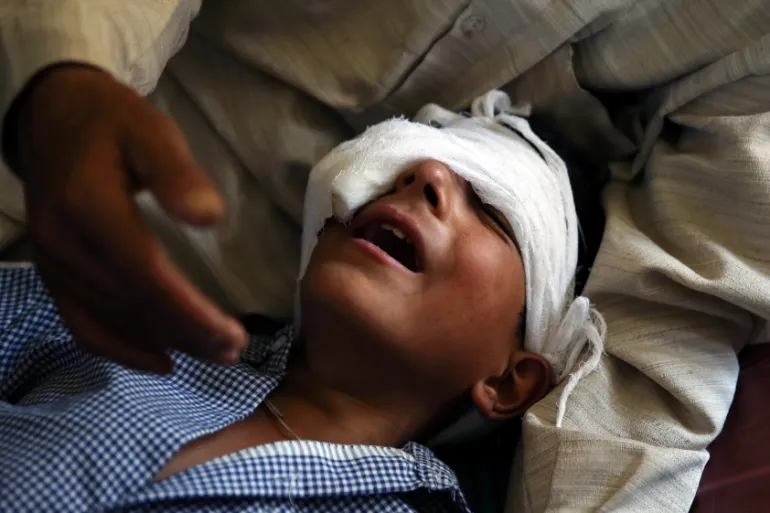
Source: Reuters
The use of this weapon has resulted in blinding some as young as 18 months. Or, girls like 14-year-old Insha Mushtaq, whose only crime was looking outside the window out of curiosity and her face was so badly disfigured by the pellets that it took plastic surgeons weeks to stitch it back together
“I had 92 pellets hit my face. Who says pellets are not lethal? Ask us. Pellets killed our dreams and hopes. They bruised our souls. They made our lives hell,” said A young Kashmiri man, in Amnesty International’s 2017 report, ‘Losing Sight in Kashmir: The Impact of Pellet-Firing Shotguns.’
india’s use of pellet guns in Kashmir has faced intense criticism from human rights groups and the United Nations, which has raised concerns over its violations affecting children. In a 2021 report, UN Secretary-General Antonio Guterres urged india to end the use of pellet guns against children. The indian government, however, has defended pellet guns as a “non-lethal” alternative to bullets.
In 2016, the Jammu and Kashmir High Court Bar Association petitioned the High Court seeking a ban on pellet guns. In March 2020, the court dismissed the plea, observing that “so long as there is violence by unruly mobs, use of force is inevitable.”
The High Court’s statement is a blatant appeal towards collective punishment- something that is prohibited under international law.
In her book, ‘The Right to Maim’, queer-studies scholar Jasbir Puar has written about how isr*eli soldiers wound Palestinians. It explores how states supplement the sovereign “right to kill” with a biopolitical “right to maim”. By intentionally crippling populations instead of killing them, states can extract economic value and control marginalized groups.
Similarly, we can apply this phenemenon to india/Kashmir as well. According to Puar, making a population disabled is an effective way for colonizer states to make the population dependent on them and remain in permanent subserviance. It also obscures an overt kind of violence (death) through a more innocent violence (“accidental” blinding in “self-defense”).
This is also not the first time Bollywood has projected its violent colonial fantasies onto a fictional Kashmir. Propaganda films like The Kashmir Files, Article 370, Dhurandhar are filled with Islamophobia and anti-Kashmir sentiments. They retell history according to the indian colonial project and create justifications for the ethnic cleansing of Kashmiris.
Another upcoming film, DGP Kashmir, also follows a similar colonial narrative. The director dedicates the film to Kashmir’s occupying forces: “I hope people understand the sacrifices made by police personnel to keep us safe and appreciate their efforts more.” The film also features “Kashmiri terrorists” wearing kuffiyehs. These propaganda films follow one narrative: they view Kashmiris as a blight to india.
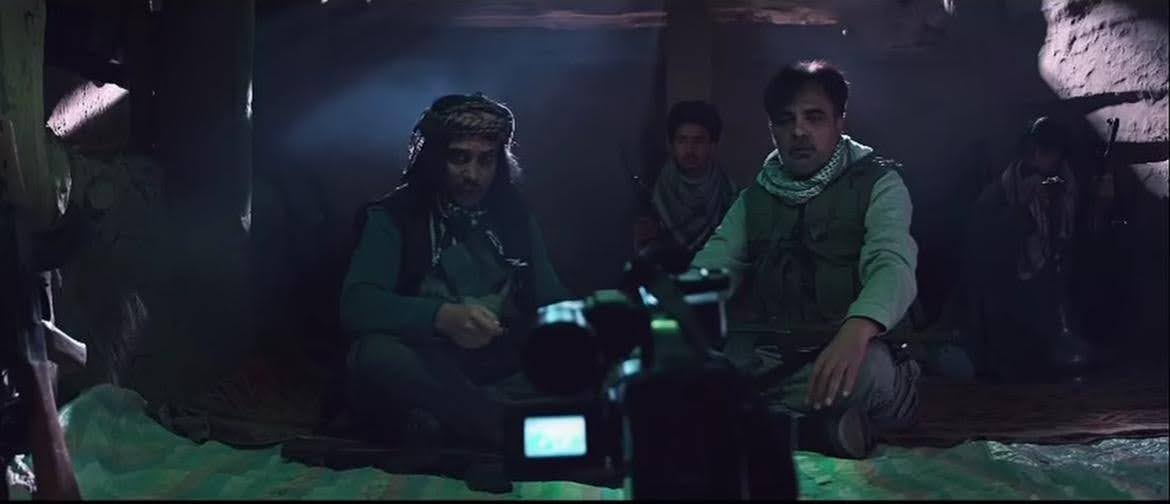
Still from DGP Kashmir
This is reflected in another sentence Devgn utters in the trailer: “Pachhattar saal ke baad jawab aa raha hai. Pathanon se kehna Chauhaan aa raha hai (The response waited for 75 years. Tell the Pathans that Chauhaan is coming).” Kashmiris are not portrayed as indigenous to Kashmir but as “Pathan invaders” from Pakistan or other enemy territories.
This tactic is also inspired by the classic colonial playbook which seeks to rewrite history so that the colonized are deprived of their claims to indigeneity and labeled as foreign invaders.
Chauhaan does not merely rewrite history, but it also emboldens and gathers indians around a singular violent fantasy and future. This is not merely fiction, it is a racist manifesto.
Stay in touch with Stand with Kashmir.
Stand With Kashmir (SWK) is a Kashmiri-driven independent, transnational, grassroots movement committed to standing in solidarity with the people of indian-occupied Kashmir in ending the indian occupation of their homeland and supporting the right to self-determination of the pre-partition state of Jammu and Kashmir. We want to hear from you. If you have general inquiries, suggestions, or concerns, please email us at info@standwithkashmir.org.
Leave a Reply